

AI Is the Answer to the Sales Growth‑Without‑Headcount Problem
Sales teams are expected to generate more pipeline growth, regardless of whether team size increases. AI Agents are emerging as the first scalable solution to meet that demand.
Aaditya Kashyap
5/9/20264 min read
For more than two decades, sales leaders have lived with an immovable constraint: if you want more pipeline, you need more people. Every planning cycle brings a bigger number, but headcount rarely grows to match it. The math has never worked — until now.
The rise of AI-powered sales automation is rewriting this equation entirely. For the first time, organizations can scale pipeline, qualify leads, and book meetings without a proportional increase in headcount. This is not incremental efficiency — it is a structural shift in how revenue growth strategy works.
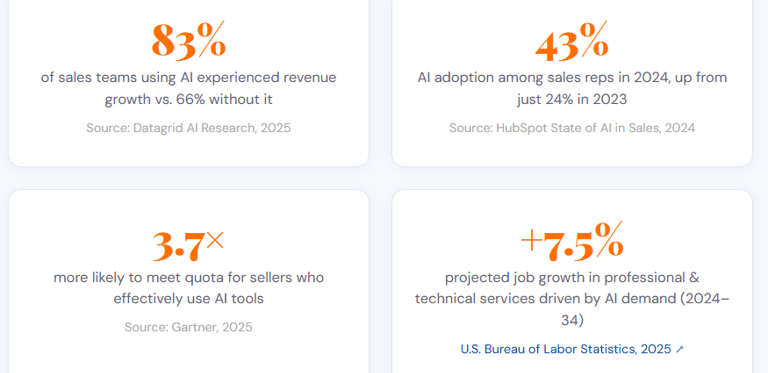
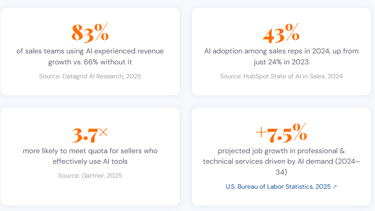
The U.S. Bureau of Labor Statistics, in its 2025 Employment Projections Report, confirms that AI is already reshaping demand across business functions — productivity improvements tied to AI are dampening the need for certain routine roles while simultaneously driving explosive growth in technical and AI-related services. For sales leaders, this is both a warning and an opportunity.
Ready to Break the Headcount Ceiling?
We build AI automation websites and connect your sales stack via API — turning your pipeline from a headcount problem into a scalable growth engine.
AI Pipeline Is Its Own Source — Treat It That Way
Most conversations around AI in sales focus on doing the same work faster. But that framing misses the real breakthrough. When deployed correctly as part of an inbound sales funnel, an AI sales agent does not just accelerate existing processes — it generates its own pipeline that would not have existed otherwise.
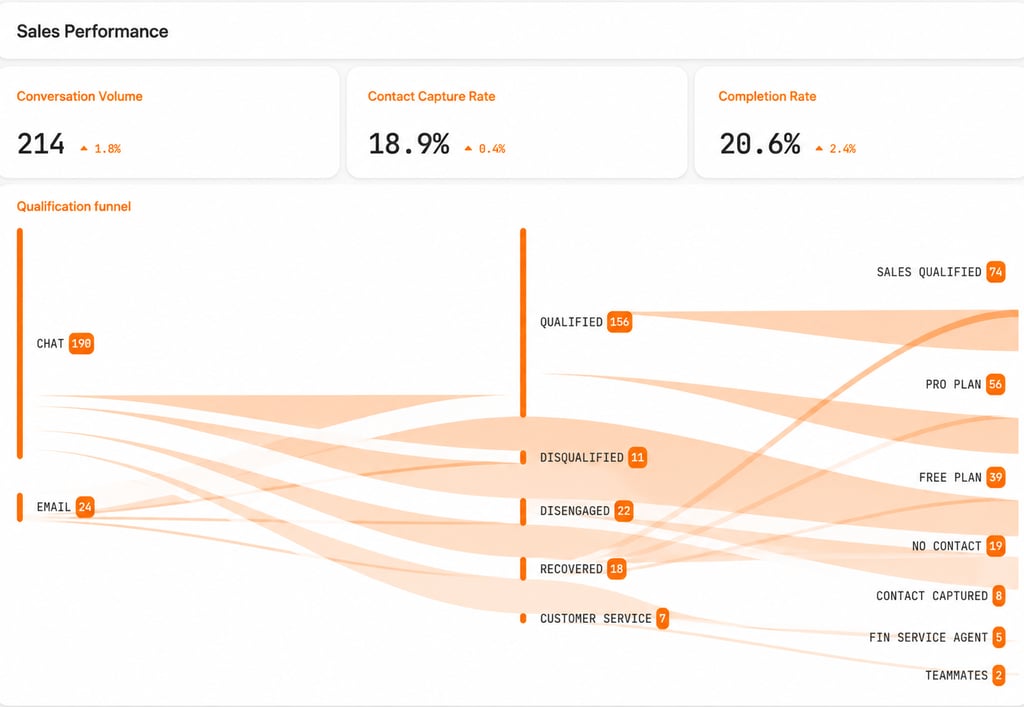
At companies like Intercom, AI agents now handle live chat qualification around the clock, in multiple languages, without capacity limits. Metrics are tracked the same way as any human rep: conversations qualified, meetings booked, and revenue generated. Last month became their highest AI-generated pipeline month ever — beating results from when humans alone handled live chat.
'The pitch stops being about efficiency gains and becomes about a new source of pipeline that didn't exist before.' — Intercom Head of Sales
The critical organizational move is to treat AI-generated pipeline as a separate source — with its own targets, its own reporting line, and its own owner. Folding it into the SDR team's numbers obscures what the agent is actually contributing. This is how you make the case to your board for continued AI investment: not as a cost-reduction story, but as a demand generation story.
What AI Actually Changes for Your SDR Team
The fear that AI replaces SDRs is understandable but misguided. The better question is: what does the SDR role become when AI handles the frontline?
With conversational AI managing first-contact qualification 24/7 — engaging high-intent prospects instantly, routing them to the right team, and keeping lower-intent visitors warm through a well-tuned sales funnel optimization workflow — SDRs are freed for the work that actually converts: phone-based qualification, multi-stakeholder relationship building, and deeper trial guidance.
💡 Key insight: Sales representatives currently spend only 34.2% of their time actually selling. The remaining 65.8% is administrative overhead that AI can automate — effectively doubling active selling time without adding a single new hire.
SDRs who come up through pipeline-building roles become your best account executives. Eliminating that function to cut costs creates a talent gap further up the funnel that takes years to surface. The smart play: let AI own the frontline volume, and let humans own the relationships that close.
The Technology Behind It: API-Connected AI Automation
What makes modern AI chatbot integration powerful is not the chatbot itself — it is the connected ecosystem behind it. When your AI agent is wired via API to your CRM, your calendar, your enrichment tools, and your email sequences, it becomes a fully autonomous sales motion. CRM automation ensures every qualified lead is logged, scored, and routed without human intervention. Predictive analytics surfaces which leads are most likely to convert, so your team spends time in the right places.
This is the architecture behind effective B2B lead generation in 2026. North America already holds a 41% share of the global AI sales automation market, and BLS research confirms that demand for AI-integrated services will drive professional services employment growth of 7.5% through 2034. Companies that build this infrastructure now will hold a structural advantage that is very difficult to close later.
Dedicated Ownership: The Secret Ingredient
The companies seeing the largest gains from AI-driven personalization and automated account-based marketing (ABM) share one common trait: they appointed a dedicated owner for the AI motion. Not someone who manages AI as a side project, but a full-time role accountable for agent performance, continuous optimization, and cross-system integration.
At Intercom, this role is called the 'AI SDR Program Lead.' It owns the strategy, implementation, and ongoing tuning of the AI agent — treating it the same way a sales manager treats a high-performing rep. The parallel to customer service is instructive: the teams that transformed their support functions fastest were those that assigned clear human accountability to the AI program, then built a continuous improvement loop around it.
For digital-first businesses investing in marketing automation and inbound growth, creating this role is not overhead — it is the mechanism that turns a one-time AI deployment into compounding pipeline growth.
The Competitive Gap Is Opening Right Now
Startups and smaller, AI-first businesses are already designing their go-to-market motions around not needing to scale headcount in the traditional way. Larger, more established organizations are mostly still running standard workflows. That is about to change — and the gap between early movers and laggards is widening quickly.
The sales pipeline growth ceiling has moved. It is no longer limited by how many people you can hire. It is determined by how well your AI agent understands your product, your customers, and your qualification criteria — and how well your systems are connected to act on that understanding in real time.
📊 By the numbers: AI-driven sales automation is expected to grow at 33% year-over-year through 2026, with 75% of companies using it reporting direct revenue contribution. The global AI in sales market, valued at $24.64 billion in 2024, is projected to reach $145 billion by 2033.
For sales leaders reading this: the constraint has not disappeared, it has moved. The question is no longer 'how many SDRs can I hire?' It is 'how well have I built and connected my AI sales system?' That is a very different — and far more scalable — problem to solve.
DigiGrow Pvt. Ltd. — Your AI Growth Partner
We design and build AI automation websites connected via API to your entire sales and marketing stack. From conversational AI to CRM automation, we help growing businesses in the USA and beyond generate pipeline without proportional headcount growth.