
Why Is Your Clinic Still Doing This Manually in 2026?
Find how AI automation can streamline appointments, patient follow-ups, reminders, billing, and clinic operations. Save time, reduce no-shows, improve patient experience, and grow your clinic faster with smart healthcare automation solutions.
Poonam
4/28/20266 min read
Let's be real for a second.
It's 2026. Your patients are booking restaurant tables with their voice, getting their prescriptions delivered same-day, and managing their bank accounts entirely through an app. But when they try to book an appointment with your clinic, they're calling a landline, listening to hold music, and waiting for someone to scribble their name in a diary.
That's a problem. A big one.
Whether you run one of the many aesthetic clinics in London, a private gynaecology practice, a GUM sexual health service, or a specialist centre under the umbrella of the London clinic UK sector — manual admin is quietly costing you more than you think. It's costing you time, money, patients, and frankly, your reputation.
In this blog, we're going to walk through exactly what UK clinics are still getting wrong in 2026, what the modern standard actually looks like, and how AI-driven automation is already changing the game for smart healthcare providers right now.
Manual Work Is Killing Your Clinic's Potential
Think about what happens in a typical day at a manually run clinic. A receptionist answers calls, checks a spreadsheet, books an appointment, sends a confirmation email by hand, then chases the patient two days later with a reminder. Then they type up notes from a consultation, manually file a referral letter, and try to remember whether Mrs. Johnson's blood test results came back yet.
Every single one of those steps can be — and in leading UK clinics, already is — automated.
According to the NHS England Digital Transformation strategy, the entire UK health sector is being pushed towards integrated, intelligent digital systems. The government's NHS 10 Year Health Plan (published July 2025) has identified AI as one of five core transformative technologies for healthcare. If the NHS is going this route, private and independent clinics simply cannot afford to be left behind.
TheNHS Transformation Directorate has been pushing healthcare providers to digitise services, connect them, and use technology to enable genuine service transformation — not just digitise paper, but actually rethink how care is delivered.
Is Your Clinic Still Behind?
Book a Free Clinic Digital Audit with DigiGrow Today — We'll show you exactly where you're losing time and money, and how to fix it.
What "Modern" Actually Looks Like in 2026?
Let's go through the key areas where automation is now the standard — not the exception.
1. Automated Booking & Patient Reminders
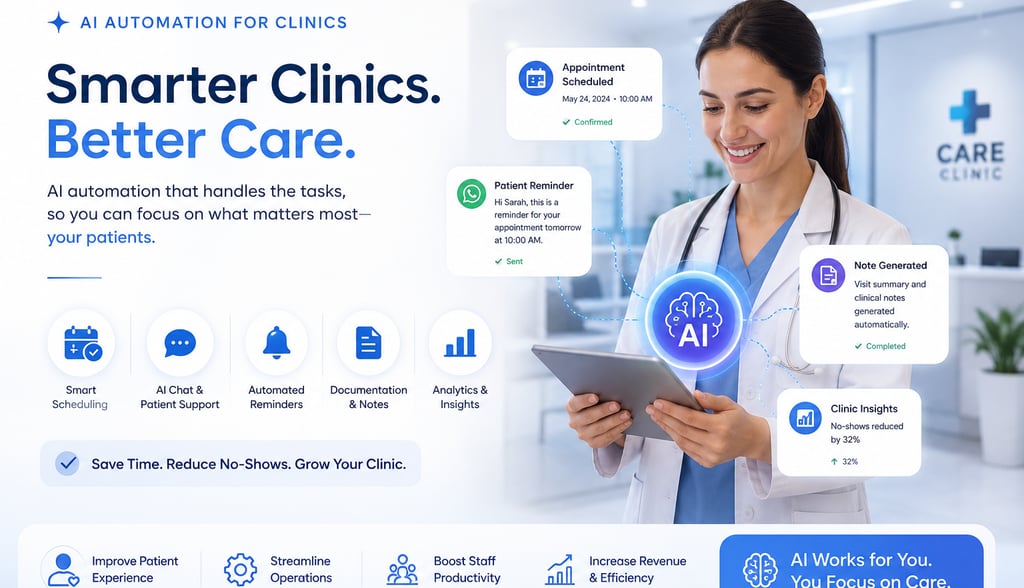
Patients hate calling to book. They want to do it at 11pm from their sofa. Automated scheduling software now handles online bookings, sends instant confirmations via text and email, and fires off reminders 24–48 hours before an appointment — all without anyone lifting a finger.
For aesthetic clinics in London, where no-show rates can be brutal (you've already blocked out an hour for a dermal filler consultation nobody turned up to), automated reminders alone can save thousands of pounds a month.
This isn't fancy technology. It's a basic expectation. And yet, plenty of clinics are still doing this manually.
2. GDPR-Compliant Electronic Health Records (EHR)
Paper records in 2026 aren't just inefficient — they're a liability. The Information Commissioner's Office (ICO) sets out clear obligations under UK GDPR for how patient data must be stored, accessed, and protected. Clinics that are still storing patient notes in filing cabinets or unsecured spreadsheets are sitting on a compliance time bomb.
Modern EHR platforms store patient notes, consultation records, invoices, telehealth data, and referral letters all in one place — securely, with full audit trails. They integrate with telehealth tools so whether a patient comes in person or joins a video call, their record is updated in real time.
The Care Quality Commission (CQC) — which regulates all healthcare providers in England — expects to see evidence of clear clinical documentation and record management during inspections. A digital, integrated system makes that easy. A pile of paper makes it a nightmare.
3. AI-Assisted Administration
Voice-to-text transcription for consultation notes. Auto-generated referral letters. Smart sorting of incoming correspondence. Automated invoice generation. All of this is now possible with AI tools built specifically for UK healthcare.
Think about how much time your clinical staff spend typing up notes after a consultation. That's time they're not seeing patients. AI transcription tools can take a practitioner's verbal notes and turn them into structured clinical records in seconds. It's not science fiction — it's already being used in forward-thinking gynaecologist clinics in United Kingdom, private GP practices, and specialist clinics across the country.
4. Integrated Care Pathways and HL7 EHR Integration
Here's one that catches a lot of clinics off guard. When a patient's blood test results come back from the lab, where do they go? If the answer is "someone emails them over and the receptionist prints them out and puts them in a folder," you have a problem.
Modern integrated systems use HL7 messaging standards so that lab results, GP correspondence, and diagnostic reports flow automatically into the patient's digital record. No manual transcription, no lost results, no delays.
For clinics that sit at the crossroads of multiple care providers — like gynaecologist clinics in United Kingdom that work alongside GPs, labs, and specialists — this kind of integration isn't a luxury. It's a patient safety issue.
Let's Talk Specific Clinic Types
Aesthetic Clinics in London
The competition among aesthetic clinics in London is fierce. Patients have enormous choice — and they make decisions fast, often based on how smooth and professional their first interaction with a clinic feels. If your booking system is clunky, your confirmation emails are slow, or your aftercare follow-ups are inconsistent, patients will simply go somewhere else.
AI automation helps aesthetic clinics in London standardise the patient journey from first enquiry to post-treatment follow-up. Think: instant quote responses, automated pre-treatment questionnaires, post-treatment care reminders at 24 hours, 48 hours, and one week. All on autopilot.
GUM Clinics London
GUM clinics London face a unique challenge: high patient volumes, sensitive data, and significant pressure on appointment availability. The NHS GUM services across boroughs — from Dean Street in Central London to the Ambrose King Centre in East London and Burrell Street Clinic in South — are already leveraging digital tools to manage walk-ins and online bookings efficiently.
For private GUM clinics London, the expectation is even higher. Patients expect confidential, fast, digital-first interactions. Automated online booking, secure messaging, and digital test result delivery aren't differentiators in 2026 — they're table stakes. If your clinic is still managing sensitive sexual health appointments over the phone with manual record-keeping, that's a serious gap.
The London Clinic UK — Private Specialist Sector
The broader London clinic UK private sector — covering hair transplant surgeries, specialist diagnostics, orthopaedics, oncology, and more — has set the bar high. Leading private hospitals like The London Clinic on Harley Street offer appointments within 48 hours, advanced diagnostics, and a fully joined-up care experience.
Smaller independent clinics operating in the same market need to match that standard of responsiveness. AI-driven admin tools make it possible to punch above your weight — giving patients the same fast, seamless experience without needing the overheads of a large hospital.
Gynaecologist Clinics in United Kingdom
Women's health is one of the fastest-growing areas of private healthcare in the UK. Patients seeking care from gynaecologist clinics in United Kingdom are increasingly expecting a digital-first experience: online consultations, self-collect test kits, smart scheduling, and personalised follow-up care.
Preventive gynaecology, nutritional wellness programmes, and integrated medical care all require coordinated record-keeping across multiple practitioners. Without digital systems, that coordination breaks down. With automation, a patient's full care journey — from initial consultation through to specialist referral and nutritional coaching — can be tracked, managed, and communicated seamlessly.
What Happens If You Don't Change?
Let's not sugarcoat it. Clinics that don't adapt are going to lose. Patients will go to providers who respond faster, communicate better, and make the whole experience feel effortless. Your best staff will get burnt out on admin they shouldn't be doing. You'll face increasing compliance risk as UK GDPR enforcement tightens. And your revenue will plateau because you can't scale a manual operation.
The NHS is investing billions in digital infrastructure. The government's AI Opportunities Action Plan is pushing AI adoption across every sector, including health. Private and independent clinics that align with this direction will be positioned to grow. Those that don't will be left explaining to patients why they still can't book online.
The Bottom Line
This isn't about replacing the human touch in healthcare — it's about removing the friction that gets in the way of it. When your admin is handled by smart systems, your clinical staff can focus on what they actually do: providing excellent care.
Whether you're running aesthetic clinics in London, GUM clinics in London, a gynaecologist clinic anywhere in the United Kingdom, or a specialist private service under the wider London clinic UK banner — the time to act is now. Not next quarter. Now.
The clinics winning in 2026 are the ones that stopped doing things manually.
Your Brand. Your Market. Your Success , in USA
© 2022 DigiGrow Pvt. Ltd. All rights reserved.
Contact info
Chandigarh, India, PIN code - 160102